


Setsubun Dinner and How to Eat Eho Maki 恵方巻き
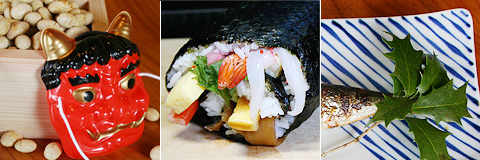
Eho is the direction of the god of fortune and happiness and she changes her direction every year. The ehomaki, rolled sushi, with 7 lucky ingredients, is eaten without pause or chatter while facing the auspicious direction of the year. We are hoping for an extra happy and prosperous year, so we bought a lunker ehomaki with 12 ingredients.
We hoped to buy our ehomaki this year from Hisago Sushi again, but they were sold out. Hisago, a very traditional Kyoto shinise makes an ehomaki (seen below) is not traditional in appearance but it tastes good and looks super funky. This year, we settled on a monster 12 ingredient sushi roll from an up-and-coming company in Osaka that we scored at Kyoto Takashimaya. It was pretty huge, so we cut it in half and split it. It was one of the tastiest sushi rolls I have ever eaten, with lots of fresh and yummy ingredients.
We also grilled some super-sized sardines. Miwa can’t future out why the demons don’t like sardines, they taste really good to us! (See this Setsubun article for more about demons, sardines and holly.)
Setsubun Dinner and Decoration
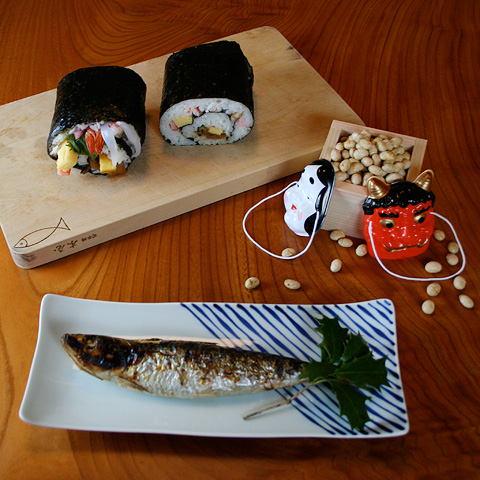
Setsubun 12 Ingredient Ehomaki
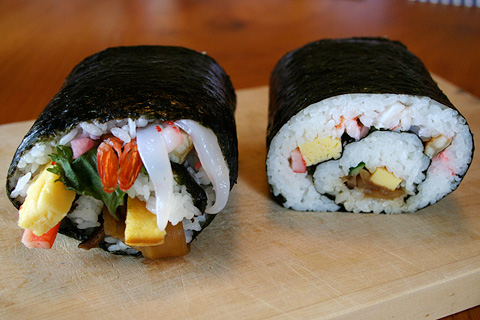
One half of this ehomaki KO’ed Miwa. I have great piks of her out on the floor, but she won’t allow me to post them. She claims that one half of this ehomaki was is equal to 6 bowls of rice. (Not even close.)
Origin of Ehomaki
There are two competing theories regarding the origin of ehomaki. One says that merchants in the late Edo and early Meiji eras Senba (a part of Osaka) ate this special makizushi at Setsubun hoping for a new year of prosperity. Therefore this custom is more common in the Kansai region, rather than Kanto. Another theory states that a samurai under Toyotomi Hideyoshi coincidentally ate makizushi at Setsubun the day before a battle and was victorious; it then quickly became a custom. Peko likes the merchant theory best.
Ehomaki Sushi Roll
Usually ehomaki has seven ingredients. Seven Gods of Fortune, also known as the Seven Lucky Gods 七福神, are the origin of this. Seven is considered the luckiest number in Japanese culture too. The usual ingredients include kampyo, shiitake, eel and egg. However, ehomaki can contain more ingredients. The metaphor of the roll is essential, ‘roll’ is the ‘maki’ in makizushi, and all that good fortune is rolled-up tight in the sushi roll.
How to Eat Ehomaki
The ehomaki custom requires that you face the eho, auspicious direction for the year, this year it was east by northeast, because that is the direction the the god of happiness and good fortune. The god is called Tokutoshijin.
So, you get your ehomaki, face the direction and eat the entire makizushi without stopping, eat quietly, don’t talk to anyone until everyone is finished and most importantly, make your wish for the new year. Some say that you should close your eyes while you eat too. Oh, and eat one whole roll yourself.
Marketing: The Death and Rebirth of Ehomaki
After WW2, eating ehomaki at Setsubun nearly disappeared in many regions, especially large cities. The nori (seaweed) union got together, planned a big promotional campaign and reintroduce the culinary culture to Japanese which they launched in 1973. It was obviously a big success.
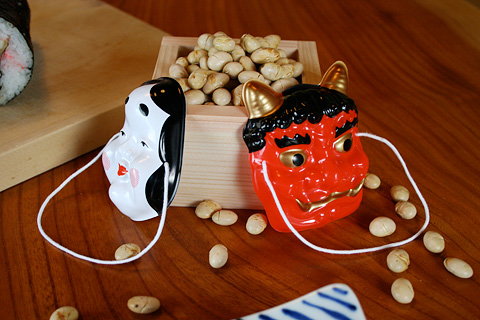
Setsubun Mame Beans, Otafuku and Oni Masks
Setsubun Grilled Sardine with Hiiragi
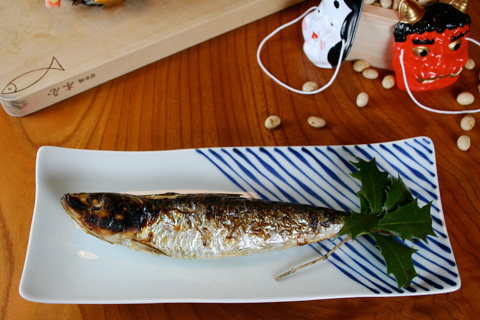
‘Stinky’ grilled XL sized sardine, tastes great to us but the demons can’t stand it.
Last Year’s Ehomaki from Hisagozushi
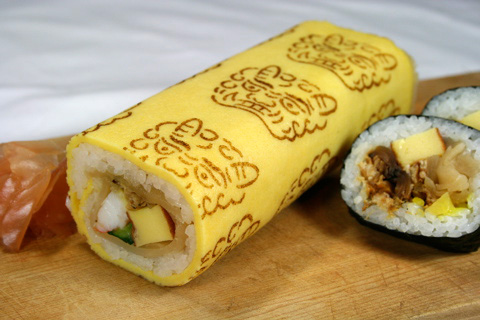
The yellow makizushi from Hisago Zushi is now a legend in Kyoto, and has the oni demon branded on the egg roll. We waited in line again this year but were unable to purchase one. The makizushi to the right is the conventional ehomaki.
Links
KyotoFoodie Setsubun Articles
Setsubun Ehomaki, Mame-maki and Grilled Sardine (this one)
Setsubun Customs: Hiiragi Iwashi (Holly and Sardine Head)
(2008) Setsubun: The Day Before Spring, Demons, How to Eat Eho-Maki and Throw Your Beans



Whoa, that’s one big sushi roll! Looks delicious!
Amazing, learned a bunch.
My thanks to you!
Hi again from San Francsico! On my last visit to Kyoto we brought back for friends some of those black mochi triangles. Do those have a special name? I know they are specific to Kyoto. Do you know of anyone who sends those to the US?
thanks,
david
Hello gaga, Yes, a real lunker. I really wish the Miwa would let me put up the photo of her on the floor, KOed from eating that maki in one go.
Hi jp, Thanks, your site is impressive too.
Hello david, That sounds like yatsuhashi, did it look like this?
https://blogimg.goo.ne.jp/user_image/1e/a0/90725f8da26761aa6189cc3bad0e18b3.jpg
Also, did it have a bit of cinnamon flavor? (Some do, some don’t.)