


Sea Bream Japanese Feast: Tai Sashimi, Tai Meshi, Tai Nitsuke 鯛
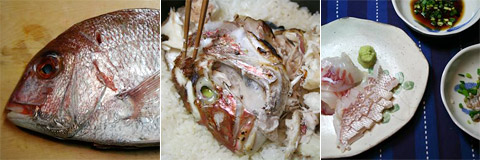
Sea bream, or ‘tai’ in Japanese is one of the best loved fish and an important symbol in Japanese culture. It is in season in the spring and is called the ‘King of Fish’ in Japan. A whole tai is quite expensive and is enough for an entire meal. Here are three ways to eat one tai.
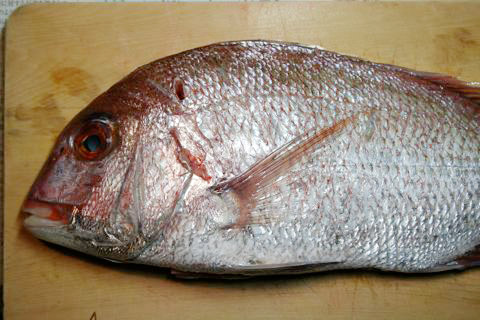
Itadakimono: Yesterday I was over at Kichisen with a friend chatting with Mr Tanigawa, as I was leaving Mr Tanigawa ordered one of his students to get a tai for me to take home. When they showed the beautiful red fish, I couldn’t believe my luck. It was huge! He also gave me some greens that I had not heard of before: hakusaina.
Sea Bream Feast Served
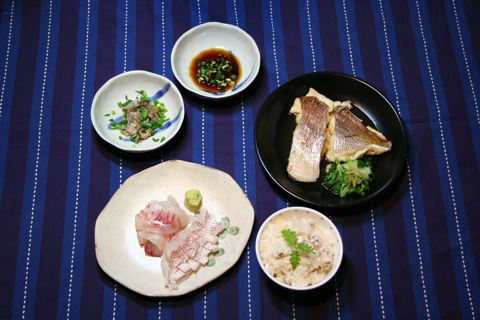
Sea Bream ‘Tai’
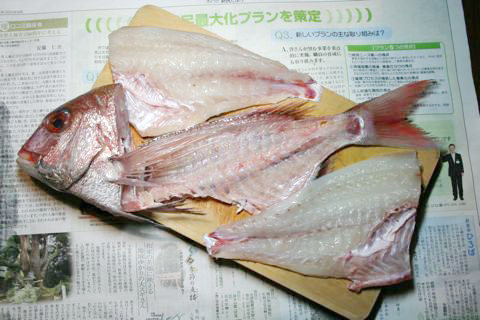
Sea Bream ‘Tai’ – Cleaned
Sea Bream Feast Served
Tai Meshi (Sea Bream Rice) – Ready to Cook
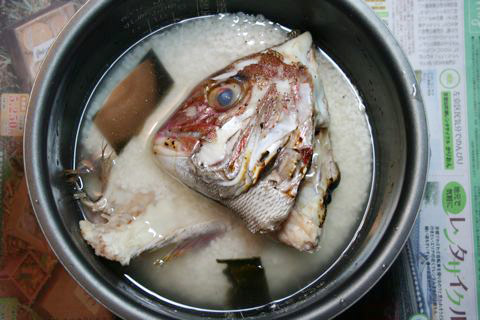
Tai Meshi (Sea Bream Rice) – Cooked
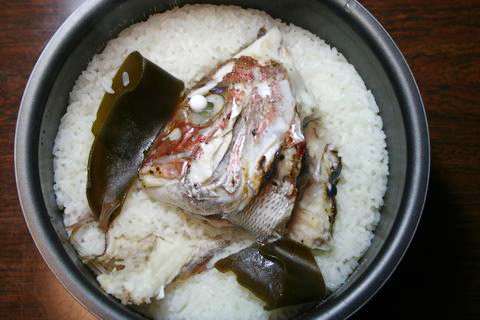
Tai Meshi (Sea Bream Rice) – Removing Meat from Head
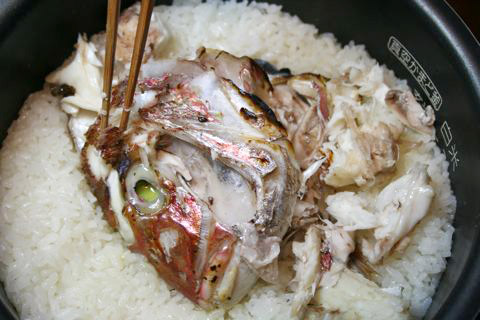
Tai Meshi (Sea Bream Rice) – Removing Meat from Head
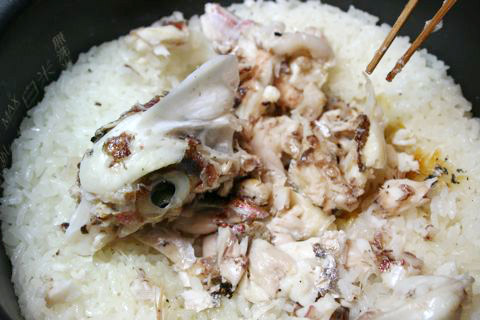
Tai Meshi (Sea Bream Rice) – Removing Meat from Bones
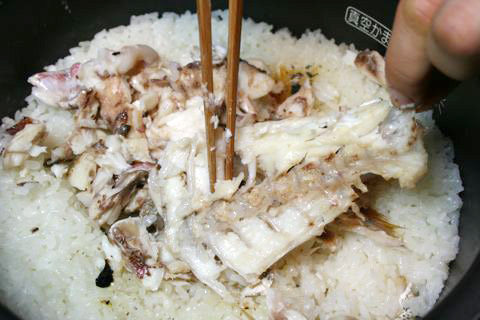
Tai Meshi (Sea Bream Rice) – Removed Bones
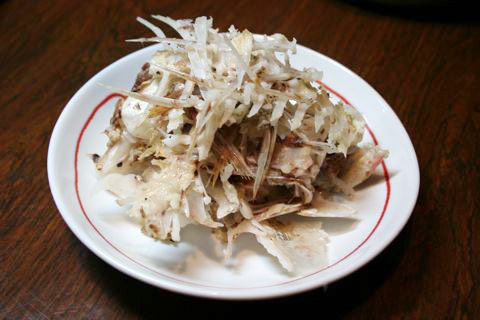
Tai Meshi (Sea Bream Rice) Served with Ki-no-me
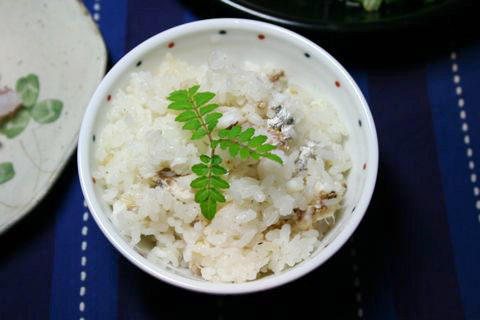
Ki-no-me is the leaf of the sansho plant.
Tai Meshi
Tai-meshi is made a number of different ways and Mr Tanigawa recommended that we use the head for that. (We put the spine in too and that was a mistake as it left a fair number of bones in the rice. Surprisingly, we were able to strip the meat from the head, even the lips — with only getting a few small boney bits in the rice,)
The idea here is that the head of the tai will make a lot of excellent dashi (soup stock) for the rice. And that it did! Also, nothing should go to waste. First, the tai head is grilled shioyaki style, just for a minute or so on each side. Then the head goes in the rice cooker and is cooked on top of the rice with some ryorishu (cooking sake), salt and a bit of shoyu.
Removing the meat from the head is not as difficult as you might expect. Tai-meshi is usually garnished with ki-no-me, which is the leaf of the sansho pepper bush.
Tai Nitsuki – Simmering Sea Bream with Greens
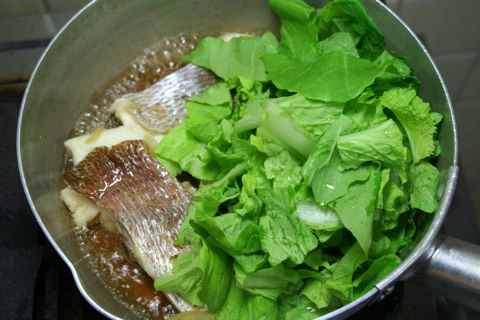
Tai Nitsuki – Simmered Sea Bream with Greens

Tai Nitsuke
We made a light dashi with just a few small slices of ginger and simmered half the tai in it. As the end, we added the hakusaina greens as per Mr Tanigawa’s instructions. For me, it is hard to beat fish simmered in sake and shoyu.
Tai Sashimi
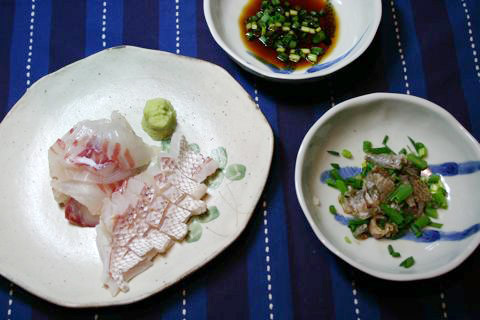
Tai Sashimi
The bottom half of the fillet is eaten raw, the skin is stripped off and it is simply sliced. Meanwhile, on the other half of the upper half of the fillet, and the skin that was stripped off the lower half, Mr Tanigawa poured boiling water and then plunged it into ice water.
The scalded skin is sliced thin and mixed with scallion and ponzu. (Ponzu is a citrus juice and vinegar based shoyu dipping sauce. I got this ponzu at a shoyu shinise in Kyoto and it includes grapefruit juice, a novel ingredient!) This is similar to the fugu ‘teppi‘ dish.
The ‘scalded’ sashimi with skin is dipped in ponzu and the ‘raw’ sashimi is dipped in the usual shoyu and wasabi. This contrast was particularly wonderful and the kind of surprise you get at a restaurant like Kichisen.
UPDATE: My bad, I called ‘tai’ red snapper, rather than sea bream in this article and was kindly corrected by Marc@NoRecipes. (22 April 2009)




Yumm! I love tai:-) I might be mistaken, but it’s tai “red sea bream”? I think red snapper is a slightly different fish with a more narrow pointed nose.
Hi Marc, Oh! My dictionary says both. This online dictionary says the same: https://ext.dictionary.goo.ne.jp/leaf/je/20883/m0u/鯛/
I image searched both names in English and tai in Japan definitely looks like what most comes up as sea bream in search results.
This article about tai, Japan’s kind of fish, written by a professor only says sea bream.
https://www.kikkoman.com/foodforum/thejapanesetablebackissues/12.shtml
ふ〜〜〜ん
Fantastic! so well done,so neat and artistic.
Kudos to the chef!
We use th ered snapper alot here in New Zealand. it is very tasty and a good price. Steamed with ginger it is wonderful!
While the correct name of Tai in English is Sea Bream, it is closely related to the Red Snapper, and in fact, according to Elizabeth Ando’s excellent Japanese cookbook, Washoku, Tai is a member of the snapper family. Certainly any of the recipes for Tai are good for preparing Red Snapper, and other members of the family, which are more familiar to other Pacific Rim places, such as Australia and California. In Japan, when I lived in Kanazawa, the Black Snapper, or Kurodai, was highly prized.
I have yesterday made Tai Meshi and Tai Nitsuke according to your “recipe” and both were delicious, especially the Tai Meshi which was excellent! I am always looking for new ways to cook Japanese food and your website always has something of interest for me. Thank you so much for an excellent blog!
Tai correctly refers to “red sea bream”(Pagrus major) which are in the family Sparidae (bream). Sparidae are not monophyletic, that is, what we call bream are not necessarily closely related species, and might properly belong to other families. Sometimes, the closely related Australian snapper (aka New Zealand snapper, pink snapper, pink sea bream, or squirefish) (Pagrus auratus) is substituted for red sea bream. Although called “snapper”, the squirefish is a bream. The genus Pagrus is distantly related to picarels (family Centracanthidae). Red sea bream are about as closely related to red snappers as they are to fresh water bass or tilapia.
In the US, the generic “snapper” at many fish mongers is actually squirefish. You can be sure if the origin was Australia or New Zealand. The “red snapper” sold at many fish mongers is also a substitute, frequently vermilion snapper, pacific red snapper, or even squirefish. In the southeast, the red snapper is usually legit. The red sea bream may actually be a related species found in the atlantic (Pagellus bogaraveo) which has the same common English name as the Japanese madai. It is illegal to call something “red snapper” which is anything other than a northern red snapper, so tai should always be translated as “red sea bream”.
The “tai (red snapper)” on the menus of many sushi shops in the US is at best squirefish, and at worst tilapia (usually the later). The deception at most shops is a combination of the ignorance of the non-Japanese owner, and a sushi fish monger that promotes tilapia and/or squirefish as a substitution for tai. The box the fish comes in is usually labeled properly. A handful of Japanese owned sushi shops will often use “red snapper” on the menu, but serve the traditional red sea bream (madai) or squirefish. This is done because the shop owners feel that people do know what a snapper is, but don’t know what a bream is. This is a play on the popularity of red snapper, and is illegal.
Real red snapper is almost never found in US sushi shops, and real madai is only found in Japanese-run shops.
What we call snappers are in the family Lutjanidae. Red snapper (Lutjanus campechanus) is native to the Gulf of Mexico and the Caribbean . It does not have a Japanese name, nor is it a traditional fish in sushi.
Red sea bream and squire fish are closely related, and do look and taste similar, but they can be distinguished side-by-side. They are nothing like real red snapper.
Nice reply Tony C., the common names are confusing and good to have the scientific one to clear things up.
I eat a lot of Tai here in Japan, and it is very similar to juvenile NZ Snapper (the Australian Snapper is a myth, they stole it from us because it’s good, just like Crowed House…ha ha! They can keep Russell Crowe).