


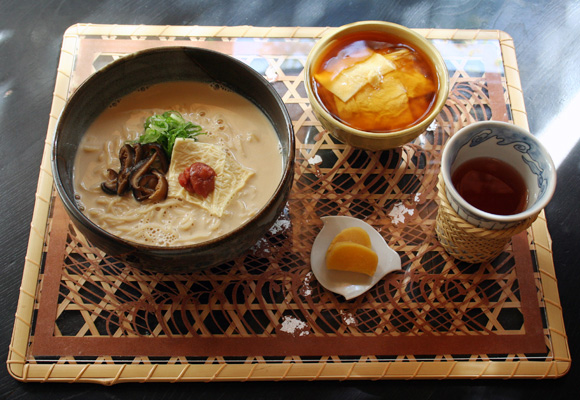
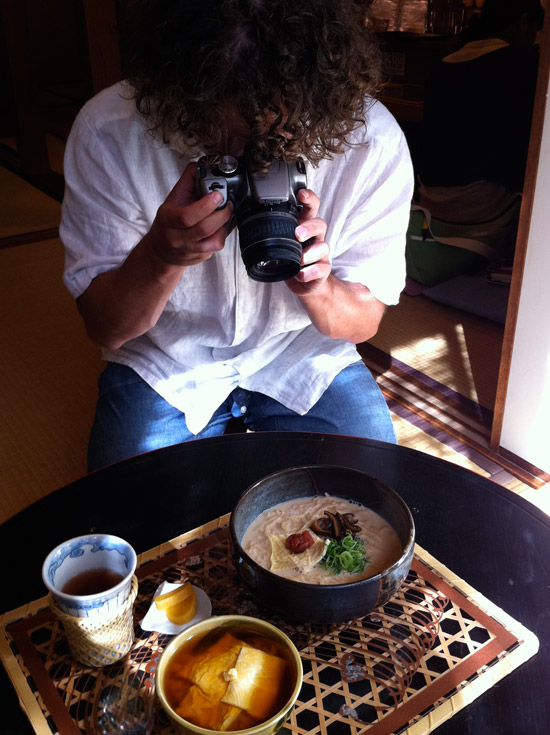
Mamezen is another Kyoto culinary treasure and if you are into noodles and, or soymilk dishes, you should definitely put Mamezen on your list of places to ‘foodie’ when you visit Kyoto. Mamezen serves ramen in a unique soymilk broth: Mamezen Soba. I like the ‘omakase set’ which is soymilk ramen and yuba donburi ricebowl.
Mamezen is the creation of a young Kyoto chef named Minoru Yonegawa. His family owns a very nice yudofu (simmered tofu hotpot) restaurant in Kyoto called Toka. Toka make their yudofu in a soymilk-based broth, which is very unusual, creating a very ‘Kyoto’ luxurious and rich broth with which to simmer your tofu in.
Chef Yonegawa worked at his family’s restaurant for several years and noticed that local Kyotoites really don’t come to yudofu restaurants, even if you make your broth with soymilk! He wanted to serve food that was in keeping with his roots, being based on soy but also something that would appeal to Kyoto people. Of course travelers are welcome too. While he had never seen or heard of tonyu (soymilk) ramen, he thought that he ought to be able to pull it off and that Kyoto people would like to eat it regularly. He was right, he started out serving it privately just to friends and then soon realized that he had to open his own restaurant!
Developing Soymilk Ramen Recipe
When Chef Yonegawa was developing his soymilk ramen recipe his wife was pregnant with their first child and the recipe is quite informed by that time in their life.
Japanese ramen is usually very salty and very high in calories. It is often said that you should not drink the soup after you finish the noodles. Children, pregnant women and elderly are told not to eat ramen as it is really not very healthy and their bodies cannot take the extremes of the dish. Mamezen Soba, on the other hand is made with a deeply flavored but gentle Kyoto dashi broth and rich, healthy soymilk, so drink it up!
Mamezen Soba: Ramen or Soba?
Ramen comes from the Chinese, la mian. Soba is an indigenous Japanese word. Originally, in Japan ramen was called chuka soba, lit. Chinese noodle. Today, ramen is the most common term for this dish in Japan, but chuka soba is still quite common. Ramen and chuka soba are the same dish.
I have only been to Mamezen for lunch but they do offer a dinner menu that includes the Mamezen Soba dishes and a limited number of soy-based a la carte yummies as well and quite a good selection of Japanese beer, shochu and sake, among others. Refreshing Chinese tencha is served. Tencha is the Japanese name for this tea which is made from rose buds. It has a subtle sweetness but is only very slightly flowery.
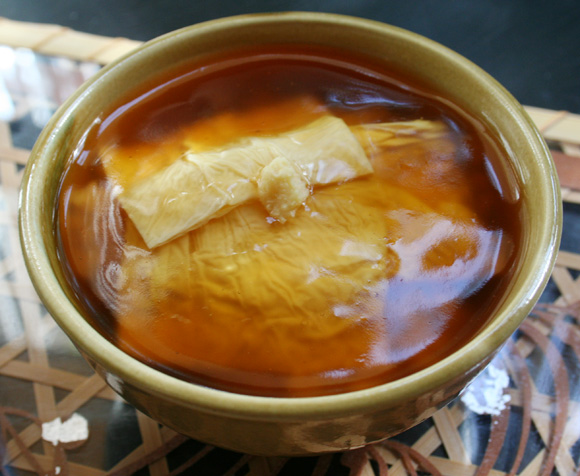
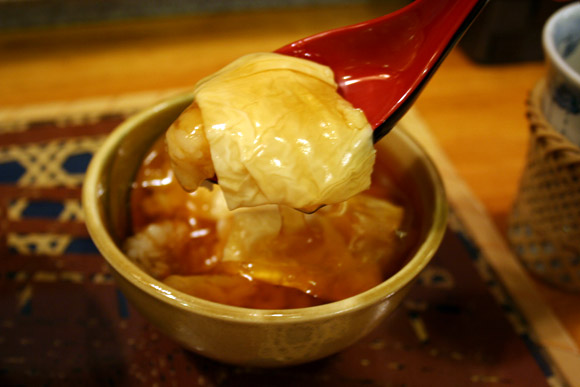
I ordered the set lunch that includes Mamezen Soba and a donburi of yuba and ankake over rice. The donburi was quite good and unlike the kumiage yuba donburi that I am familiar with.
How Did Mamezen Soba Taste?
Very good! I hadn’t been to Mamezen for quite awhile, about a year, and realized that I would be going there more often now.
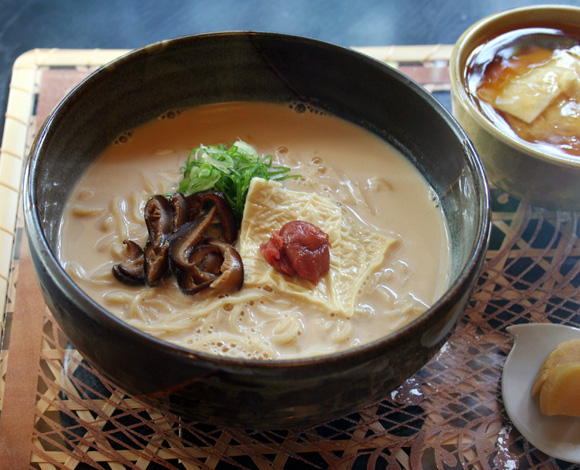
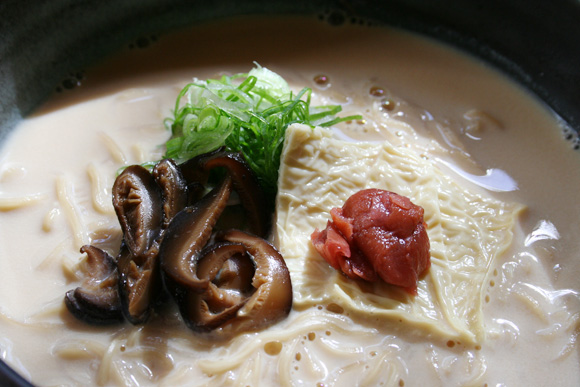
Soup: This being Kyoto, we must be dashi crazed and Mamezen is right on target. Chef Yonegawa starts by making a very rich katsuo dashi broth and then adds soymilk and simmers it down until it is thick, rich and silky. It is a very unique soup for Kyoto. I recall the soup being lighter in flavor previously. I asked the boss about it. He said that he might be simmering it longer as it thickens up the taste and density. If you like your soup stronger and richer, just ask for ‘koime’. The overall taste and feel of the soup is wonderful, I can’t think of a dish that combines the rich and pungent (dashi) with silky smooth (soymilk).
Noodles: The noodles used are very thin, something like angelhair pasta. They contain egg but I couldn’t really taste that. Personally, I am not really into thin noodles, I like them thicker and meatier. Chef Yonegawa’s choice of thin noodles is to be subtle and delicate, like Kyoto. Though not my fav, I have to agree with his choice. He might offer customers a choice to thick or thin.
Garnish: The dish is garnished with scallions, nama yuba, simmered shiitake and a bit of umeboshi. In the winter and spring, when nanohana (rape blossom) is in season, Chef Yonegawa uses it too.
Donburi: The donburi rice bowl was very interesting because it features a thick ankake sauce that is made with, you guessed it, Kyoto dashi and starch for thickening. Several sheets of namayuba is layed on top of the rice and then it is smothered in ankake with some ground fresh ginger on top.
This was a very interesting take on yuba donburi for me, which I liked very much. However, I like kumiage yuba donburi perhaps a little better. I would love to see how Chef Yonegawa would do that dish.
Veg or Vegan: The dish does use katsuo (bonito), that’s a fish, in the dashi. The noodles contain eggs. By request the dashi can be made without katsuo. Of course the egg cannot be removed from the noodles.
Do Not Miss: I have added Mamezen Soba to my Do Not Miss list in Kyoto. Rich and pungent (dashi) and silky smooth (soymilk) is something not to be missed! However, I do have a caveat. It might be a bit too ‘Zen master’ for those who are not really into Japanese and soy cuisine. The restaurant is a bit out of the way and if you really just want a delicious, but more ‘meaty’ ramen, you would probably be more satisfied with the restaurants on our Great Ramen Shops in Kyoto list. If you are sure you are into the kind of taste described here, by all means, make the trip to Shimogamo! (Twenty to thirty minutes from the city center by bus.) Also, the restaurant is closed often, call first to confirm that they are open when you plan to go.
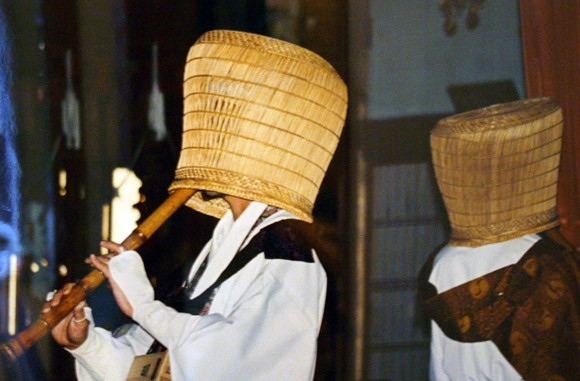
Some headgear there! It makes Devo look uninventive. His flute master name is 菊水流尺八道準師範米川翠月. That is a long name indeed! And, many Japanese probably can’t read it.

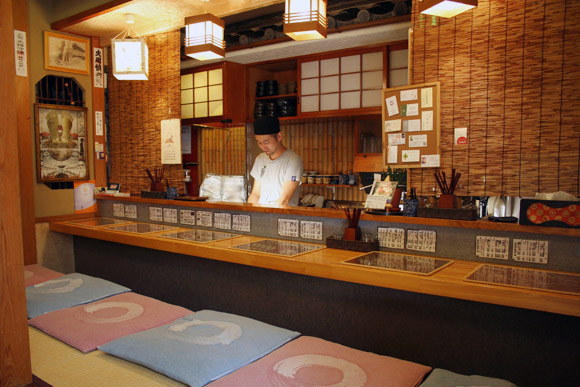
Mamezen is located in the historic Shimogamo neighborhood of Kyoto, a bit north-east of the UNESCO World Heritage Site, Shimogamo Shrine. Mamezen is a very small and personable restaurant. Owner chef Yonegawa is a really, really nice guy. His wife helps run the restaurant and his two beautiful young children poke their heads in regularly. In addition to being a chef, Yonegawa is also a bit of a Zen master and is a master of the Japanese shakuhachi bamboo flute.
SHARE! Kyoto Support Topic: Food and Drink in Kyoto
SHARE! Kyoto Support Topic: Ramen: Great Ramen Shops in Kyoto
Tweet! Tweet! Find out what’s going on in Kyoto right now, follow me on Twitter.
Mamezen in English
English Menu: yes
English Website: none
Service: Warm-hearted and friendly
Price: 1,000-1,500 yen
Hours:
lunch: 11:30-3:00 pm (2:30 pm last order)
dinner: 7:30-11:00 pm (10:30 pm last order)
closed: Wed, Thurs and some other days (Zen master chef isn’t a salary man), call the mobile number listed below before you go.
Location and Access: Shimogamo neighborhood. Best accessed by bus, taxi, bicycle or on foot. Nearest bus stop is on Kitaoji Street.
Address: Kyoto-shi, Sakyo-ku, Shimogamo, Higashi Takagi-cho 13-4 (京都市左京区下鴨東高木町13-4)
Telephone: 075-703-5731
Mobile: 090-1153-5297
Near Sightseeing Spot: Kamigamo and Shimogamo Shrines, both UNESCO World Heritage Sites. These shrines are older than even the ancient capital!
Map
View OpenKyoto/KyotoFoodie Map in a larger map



Definitely would like to visit.
Hello TK, Yes, you must! I love the photos on your blog, are you still in Japan?
this is amazing. i love soymilk so i can imagine how creamy and buttery that broth must taste! Definitely a must try I believe, at least for me it is now.
Yes, I’m here in Kyoto. Thought to take a vegetarian friend to Mamezen on Friday but unfortunately it was booked out (-thanks for the ‘call in advance’ advice) so we went Sunny Place. Will try again soon.
Have you heard of kongguksu? It is a somewhat similar dish from Korea, only it is usually served cold.
aahhh.. i`ve been reading your blogs for a while. Here I am in Kyoto and thought of having Mamezen Soba on my last day, unfortunately it:s wednesday tomorrow. sob….
I wish we have this in Australia.. Any suggestion for another Kyoto do not miss food?
Yet another place to try! I just ate dinner, but am hungry again from reading this. I love kumiage yuba too. Ah, Kyoto!
Thanks for the tip – quite tasty!
Brief: tasty New Japanese cuisine, in a family-friendly neighborhood restaurant setting. Tasty and worth a visit if in the area, but not “must see classic”.
Location: this is on a side street, not the main street (which is Kitaōji). To find, start from the bend in the road on Kitaōji – there’s an intersection with a traffic light, and Mamezen is very close. Go south from the main road, then immediately west (right) onto a small side road, and Mamezen will be on the south (left).
I’d rate this a *qualified* recommendation (as the article body reads), not the “must see” label at the top. Definitely go if you’re into yubo/tofu (or innovative ramen), but if you want classic Kyoto cuisine or Japanese cuisine, there are plenty of other choices, esp. if you are only in Kyoto on a brief trip (e.g., Toriiwaro (oyako don), Owariya (soba), Tsunamichi (udon), Izuju (Kyoto sushi), Hanaore (mackerel sushi) – I would place all of these as much more of a “must see” than Mamezen). It’s worth dropping in if you’re in the neighborhood, but it’s a bit of a schlep.
Food-wise, it is delicious; I’d recommend a set (when I went the side for the omakase was also ankake don, and that seems the usual). Note that while the menu reads “small ramen” with the set, you can get larger sizes, and I’d recommend regular size (for adult men) (portions are not large, though the food is hearty, so it’s worth going a bit larger; this is not a “regular is really big” place).
The soup is very rich and creamy, like a Japanese take on “cream of …” soup, and the donburi was also very fragrant (ankake don is often pretty indifferent); the garnishes work very well, providing flavor and fragrance without being overwhelming (think “garnish for flavor”, not “substantial topping”). The tofu background was clear – the yubo was very generous and good, and the soy milk broth is really the star. Noodles were fine (both taste and diameter – I prefer thinner), but not the star. The pickles were also surprisingly good (too often an afterthought), and the tea was unusual and tasty – the whole meal exuded care and flavor.
This is not typical ramen (it’s healthy, for a start) – it’s in fact a nice change (I’ve been getting a bit tired of ramen of late), but if you want classic/definitive ramen, go to other places first.
Calling it “Kyoto-style” feels a stretch – it’s rather more “New Japanese” or “New Kyoto” (ramen? for real?) – there is some spiritual “Kyoto”-ness (esp. yubo and garnishes), but it’s definitely a younger generation. It’s a nice change if you’re used to standard Japanese food, but if you’re not, it may just be a bit weird. (Tasty though.)
Location- and atmosphere-wise, it’s very much a neighborhood family restaurant – the atmosphere, decor, clientele, and associated events are very much “local social hub”. Yonegawa is also quite friendly, and the kids are cute (though a bit shy). Seating-wise, there are a few tables (I think 3 tables of 4 people each?) on a tatami mat, and counter seating (6 seats). It’s definitely kid-friendly.
Time-wise, it’s a bit slow (everything made to order; I was there when only 3 meals were being prepared, and it took 30–45 minutes). This is not a fast-food ramen joint; budget time accordingly. Indeed, it’s rather laid back and relaxed.
Went today, after calling ahead. There was an American family (couple with 2 kids), who, as I suspected, had learned about the restaurant from this blog. Another foreign couple left as I was arriving, and another came part-way through the meal, which I take as testament to the influence of KyotoFoodie! The other clientele was primarily mothers with young children (lunch on a weekday in a residential neighborhood), and there are various family-related activities listed around the room.
In sum, this is a tasty, lovely restaurant, serving innovative, surprisingly healthy tofu/yuba-oriented ramen. It’s cozy, family-friendly, and foreign foodie-friendly. I wouldn’t put it on my short list (if in town for only a few days and want to hit food sights), but I would put it on my long list, and I think many people will like it very much (many clearly do).