


Happy New Year from KyotoFoodie! Here is a little taste of the New Year in Kyoto: white miso soup.
In Kyoto, people like sweet miso soup and the miso soup for O-shogatsu, or Japanese New Year, is especially sweet, surely the sweetest miso soup in all the land. The soup is called o-zoni and this article is about Kyozoni, or Kyoto-style o-zoni. The source of the sweetness is not sugar, but rice, which produces a rich and mellow natural sweetness. The miso paste is called saikyo shiro miso and it is made with more rice and less soybeans than usual. This is the taste of miso from the Kyoto Imperial Court of antiquity.
Saikyo White Miso
This year I ordered a few containers of Honda Miso’s Daiginjo Saikyo Shiro Miso (大吟醸西京白味噌) for my New Year’s Day ozoni miso soup and to give to a few friends. This daiginjo miso is very special because for several reasons; it is made with heaps of rice, it has little salt, it is only fermented for several weeks and is not pasteurized. Honda Miso only makes a small amount of this miso every December and it sells out in just a few days with many families having a standing order every year. If you are into Japanese sake you will probably know the term daiginjo as the finest quality sake. Saikyo means ‘west capital’ (Kyoto), this is Kyoto-style miso.
This miso is usually the lightest color miso that you can find in the miso section of a store and is ground into a very fine texture. Sakyo miso paste can also be used to make an excellent marinade for fish and chicken.
The staff at Honda Miso kindly gave me their recommended recipe for their daiginjo miso, which I improvised upon. The idea is that all the ingredients in the soup and the soup itself all be white as white is the color of celebration in Japan. Having this for breakfast makes for an auspicious start to the new year.
The ingredients are two kinds of taro (karashi imo and ko imo), nezumi daikon (a short, rat-looking radish) and round white mochi. I used ebi imo, regular daikon, kintoki ninjin carrot, green yomogi and yellow awa mochi and a few nanohana rape blossoms. So, mine turned out very colorful and festive.
Like all o-shogatsu food, the vegetables in the classical Kyoto recipe have symbolic meanings: having smooth human relations, having many descendants, being promoted in the world, not to become jealous or petty and to put down strong roots.
As I was having my soup, I was thinking that this daiginjo saikyo shiro miso would make an excellent ice cream flavor. I wish I had an ice cream maker to try and make some!
Usually miso paste is quite pungent as it is fermented, it is also quite salty. Honda Miso’s Daiginjo Saikyo White Miso paste itself is a treat to taste. It is buttery in fragrance and has no whiff of ferment. The taste is lightly bean-like and quite buttery, even with a hint of caramel. The texture is completely smooth. The ingredients are simply rice, soybeans and salt. There is no koji and the salt content is about one-tenth that of regular miso. The cost is about 1,500 yen ($15) for 500 grams. Now that is some expensive miso! I highly recommend that you ring in the new year with some daiginjo saikyo white miso if you can get your hands on some.

Kyozoni Served
The ingredients that I used are all O-shogatsu, with the exception of nanohana. Nanohana heralds the coming of spring and New Year’s Day is the beginning of spring, so I thought it appropriate. Also, the bitterness of the nanohana is the perfect contrast to the sweetness of the white miso.
This was really good!
How to Make Kyoto-style Ozoni
Making this ozoni will take about 25-30 minutes. If you can get saikyo white miso and some kind of taro like ko imo, you should be able to get the authentic taste.
Ingredients
- mochi 4 round, bite-sized pieces
- karashi imo 4 pieces
- koimo 4
- nezumi daikon
- hana katsuo threads
- water 400 ml
- saikyo white miso 140 g
- serves 4
Preparation
1. Peel the imo and cut into bite-sized pieces if need be. Simmer about 20 minutes until soft. (Use water reserved from rinsing rice to simmer vegetables. The authentic recipe for Kyoto-style ozoni is to simmer the imo with some uncooked rice as this will make the imo slightly gooey on the surface.)
2. Gently heat the water and dissolved miso paste into it.
3. In a separate pan, simmer the mochi until soft.
4. Add vegetables and mochi to miso and simmer gently for a few minutes, enough time for the daikon to cook.
5. Serve in lacquer bowls and garnish with threads of shaved katsuo.
*The bowl should not be overfilled as mine is in the photo above. It should be about three-quarters full.
SHARE! Kyoto Support Topic: Where to Purchase Basic Ingredients for Japanese Cooking in Kyoto
Tweet! Tweet! Find out what’s going on in Kyoto right now, follow me on Twitter.
Honda Miso is about a 3 minute walk from the west side of the Imperial Palace.
Map to Honda Miso Honten
View OpenKyoto/KyotoFoodie Map in a larger map



happy new year!
Hello Kat, And a Happy New Year to you!
that looks… so good.
This ozoni looks delicious. I’ve never seen such a white and creamy Japanese soup!
Happy New Year, Peko!
Hello peko
For me this food looks so good thanks for the sharing !!
I am Pierre a french foodie with a blog dedicated to creative french food come and visit me you are very welcome door is always open !! cheers from Paris France
Pierre
Mmmm I love saikyo miso, They sell it here (though I’m sure not as good as the stuff you got), but it’s obscenely expensive so I usually end up cutting it with regular shiro miso. Did you guys do a full osechi spread this year?
A happy new year to you all!
Hello Meg, Yes, when I was eating my soup I was thinking that it is more like sauce or gravy than soup. I think some Kyoto people boil it down even to thicken it.
Hello pierre, Thanks for coming to visit all the way from Paris France! I checked out your site, very nice. I have an article about French kaiseki osechi this year that you might like.
Hello Marc @ NoRecipes ちゃん, I never imagined that I would pay $15 (actually about $17) for 500 grams of miso paste. That is crazy!
I spent New Year’s Day by my lonesome with the Cheri Beagle and didn’t have any osechi this year. (Last year I was given quite a box of osechi from a certain restaurant which I didn’t think I really deserved at the time. This year I kind of thought that I might have earned one, but none came. ha ha.) I made this ozoni and has a nice tara (cod) miso nabe for dinner.
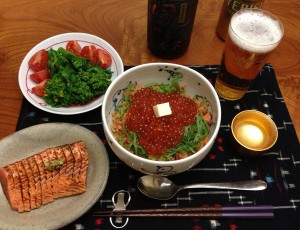
Here is a pik of my traditional Oshogatsu breakfast which I mentioned in my comment on your Osechi post.
“I do have a really great Japanese New Year’s custom. I get up and have uni and ikura donburi with a bottle of Veuve Clicquot for breakfast, and then go back to bed. It is essential to spend like $30 each on both the uni and ikura.”
You dont need a ice cream maker for ice, just use arrowroot starch, it prevents ice crystals from forming in ice cream, you dont need to stirr very often and the ice creak will be vry cramy.
I would love to see some ice cream with this miso on your blog!
I have some great sake left and think about making it into icecream too.
There is a recipe on my blog, its already translated(https://wagashi-net.de/blog/wagashimaniac/2010/01/matcha-eis/). I`m from Germany.
Happy New Year!
Lovely! Happy New Year. I’ve never had this type of ozoni. It look so delicious!!! – mary
OMG you have the best new year’s tradition I’ve ever heard of. Sign me up! Thanks for the ozoni recipe. I think it’s time you pull all of your recipes together and publish them in a cookbook. Really! The market is ready for a book that is targeted at those of us who already have a sound foundation in Japanese cooking and cuisine. We know how to make rice or other basic preparations. I’d love to have a cookbook that presents dishes such as those you’ve posted…the real home cooking of Japan. By the way, great photo. Best to Cherie and Miwa.
Yummmm!!!! Look so delicious. Great photo too. We too shared a delicous Japanes feast all the way over here in New Zealand
at our favourite restuarant Sake Bar 601. Nothing like beautiful sake and tenderly made food to make you happy.
My husband and I are comign to Kyoto in February (very soon-so excited!!) and have been back revsiting our favourite articles of yours. It really is an amazing resource so thank you.
Any suggestions on must eats would be gratefully appreciated.
Many thanks,
Michal and Chris