


Did you know that mochi rice isn’t just for sweets? When you think mochi in Japanese cuisine, most people think of sticky rice steamed and pounded and made into the myriad forms of wagashi confections. Glutinous rice, also known as sticky rice, is called mochigome in Japanese. (Kome is uncooked rice.) Mochigome can be used to cook rice dishes that are quite similar in taste, texture and cooking method to risotto. This dish is called okowa and if you like Japanese food and risotto, you ought to give this adaptable and versatile and easy to prepare recipe a try.
Recently I have made a lot of okowa because I got sick. I got a nasty cold (twice) for the first half of February and when I get sick, I get cookin, or at least eatin! I eat out or cook plenty of high calorie meals. Wagyu yakiniku is my favorite foodie cold remedy!
I happened to have several big chunks of fatty pork shoulder on hand because I had just finished making an epic batch of charcuterie with Brendon E. Also, I had also discovered a nikuman (meat-filled steamed ‘baozi’ bun) at FamilyMart this year that I liked a lot, it was filled with shio buta (salt pork). So, I salted up one of the pork shoulders and let it rest in the refrigerator for several days and then roasted it in the oven, until a lot of the fat had melted away. After it cooled I chopped it up into bit sized pieces for okowa. If you know Chinese cuisine, you can see this is heading in that direction.
About Okowa (おこわ)
Okowa was originally casual expression used by women working in the Imperial Court. The proper name for the dish was kowameshi 強飯 (こわめし). Kowameshi literary means strong, hard (kowa) rice (meshi). This is because as the dish is made with mochigome it has a much more firm and chewy texture than normal white rice or takikomi-gohan.
Throughout history mochi rice was very precious and was only enjoyed on special occasions such as festival and new years. Even today mochi rice is far more expensive than regular rice.
As mochi rice has its own sweetness in Japanese cuisine a simple seasoning with some seasonal ingredients is favored. Popular ingredients for seasonal okowa recipes include chestnuts, mushrooms, sansai mountain vegetables, bamboo shoots, white meat fish. This is then cooked with a cooking sake, mirin (sweet cooking sake) and soy sauce. Properly okowa is steamed, however modern rice cookers can make it very well with the push of a button.
There is now an okowa specialty chain shop in many of the department store food courts that offers seasonal okowa steamed to perfection.
Hearty Mid-winter Fatty Pork and Root Vegetable Okowa
Okowa is usually not at all oily but I needed some cold fighting power from this so I put plenty of pork in. Japanese believe that it is very healthy to eat root vegetables in the winter, so I added a lot carrot and burdock root. The aburaage deep-fried tofu came from Otokomae Tofuten, it is very thick and has a rich tofu flavor. I made this dish 3 times over the last 10 days or so and I must say that I liked the oiliest, sweetest, stickiest and most caramelized version the best, which this slightly more healthy recipe is not.
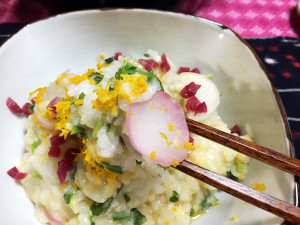
I garnished mine two different ways; one with chopped scallions and the other with julienned yuzu peel and a squeeze of yuzu juice. Yuzu was far better. If I were serving guests, I thought that I would make three versions and serve each guest all three in small portions. That would be very ‘Kyoto’, I thought. For the third garnish I thought that go with fine chopped pork that had been re-sauteed in oil with additional salt and then a squeeze of grated ginger through muslin over the rice. Or, perhaps long strips of paper thin sliced deep-fried gobo.
Okowa Recipe: Hearty Mid-winter Fatty Pork and Root Vegetable Okowa
Shio Buta (Roast Salt Pork) I ground sea salt onto the fatty pork until it has well covered and then wrapped it in cellophane and let it rest in the refrigerator for about 2 days. Next I slowly roasted it in the oven for several hours until a lot of the fat has cooked off. My unscientific analysis is that all the salt runs off the surface with the melting fat. However, the roasted pork still comes out salty enough that you couldn’t really eat more than a few bites at a time and this makes it just right for flavoring the okowa.
Gobo Burdock Root Burdock root must be well washed and then cut into strips or chunks, depending on how thick the actual root is. Next you need to perform the ‘aku-nuki’ to remove the bitterness. Normally you place the cut burdock root in water and allow to soak for 30 minutes or an hour and change the water several times. The water will turn brown and the burdock whiter. Traditionally aku-nuki is considered essential for any preparation of gobo. However, recently it has been revealed that the ‘aku’ in gobo is not aku at all but polyphenol and other desirable nutrients. Modern preparations of gobo call for soaking it in vinegar water for just several minutes to remove the dark color which will stain soups and rice dishes.
Gobo needs a good deal of heat and/or time cooking and the time required to cook rice doesn’t suffice. So, you can either cut your burdock paper thin or blanch it. This is a hearty recipe so I went with chunks of burdock and blanch them for a few minutes.
Mochigome Just mochigome can be used, however I made mine about 20% oshimugi (pressed barley), the same that is used in mugi-gohan. It is essential to first soak the mochi rice in hot water. I put my mochi rice into a metal bowl and poured on 60º C water and allow to soak for about an hour.
After soaking well, rinse the mochi rice with fresh water several times.
Caramelizers – Cooking Sake, Mirin and Soy Sauce Mochi rice has a natural sweetness but okowa gets sweeter thanks to these ingredients. A lot of chefs in Japan add and measure these ingredients with a ladle and that is what I did. My ratio is 3:2:1; 3 parts cooking sake, 2 parts mirin (sweet cooking sake) and 1 part Japanese shoyu soy sauce. One Japanese ladle full is about 35 ml, or 4 tablespoons. I think that you could even double the amount of sake and mirin from the above.
Ingredients
- 3 cups mochi rice (Japanese short grain glutinous rice)
- water
- 1 cup chopped fatty pork (salt roasted if possible)
- 1 cup chopped carrots
- 1 cup sliced gobo burdock root (blanched)
- 1/2 cup sliced shiitake mushrooms
- 1/2 cup sliced aburaage tofu (deep fried tofu)
- 90 ml cooking sake
- 60 ml mirin
- 30 ml shoyu soy sauce
- scallions and yuzu for garnish
Preparation
Rinse the rice well and add to rice cooker. Add desired amount of sake, mirin and shoyu then add required amount of water according to your rice cooker settings. I made mine with just the same amount of liquid as for regular white rice and it came out just fine.
Rinse gobo well and add all other ingredients to rice cooker. Stir the ingredients a bit to even out distribution then close the lid and start cooking.
Serve and garnish as you like.
Links and Reference
Just Bento has a good article on a more typical preparation of okowa here.
SHARE! Kyoto Support Forum: Join the Conversation!
Tweet! Tweet! Find out what’s going on in Kyoto right now, follow me on Twitter.




looks healthy & delicious!
Ooooh that looks delicious.
Yummmm! I love mochi, and pretty much any glutinous rice dish. It would be great to try something savory.
Hey!
What’s the fatty pork called in 日本語? And is it possible to buy the salted variety in the grocery store? I live in Ishikawa-ken and was thinking of making this (I’ve had it before in restaurants, omg so good!)… I know I can get everything else, but specific cuts of meat are sometimes hard to identify ^^ Thanks for a great post!
mochigome + shio buta ! deliciously deadly combi!
OMG! YUMMMMM!!!!! Thank you! I love your blog!
Love this segment and the recipe. Thanks for all your hard work to keep your loyal fans well fed and happy in the kitchen!
Just made this for supper–it was super delicious! Thanks for sharing the recipe; I’m going to be making this again. I don’t have a rice cooker or a microwave so I cooked it for 20 minutes in a heavy cast iron ‘Iwachu’ rice pot and it came out perfectly.
I love your website, I’ve been following you for the past year & your articles get better & better. I really enjoyed this dish & hope to make it soon. This post was very informative, thank you.